
Required Documents for Government Jobs in Pakistan
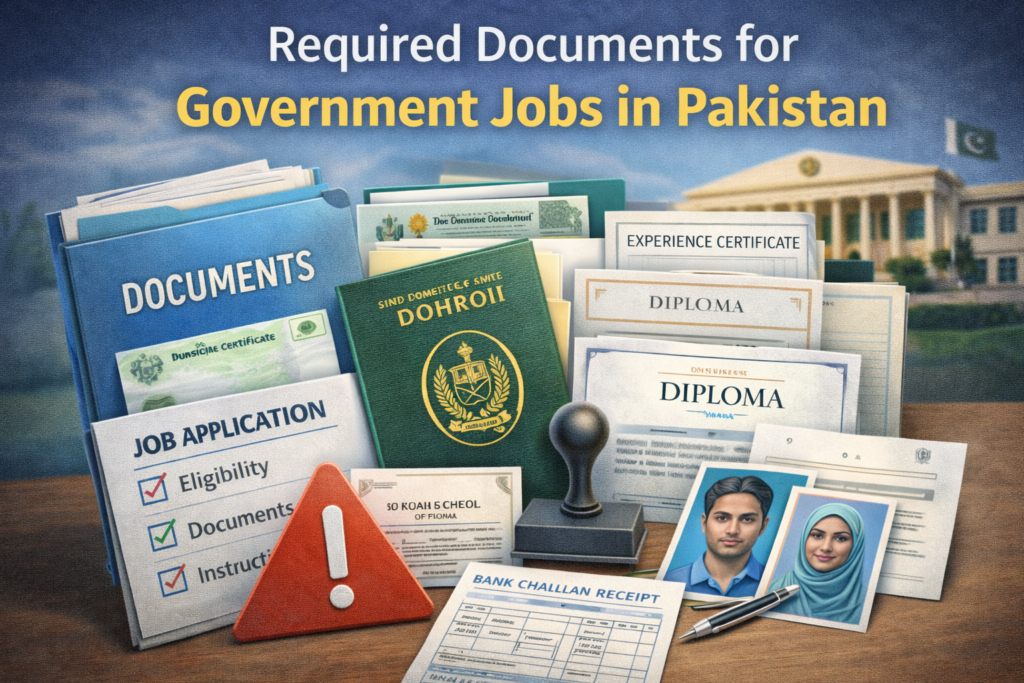
Applying for government jobs in Pakistan requires careful preparation, and one of the most important parts of the process is arranging the correct documents. Many candidates meet the eligibility criteria but still face rejection because of missing, incomplete, or incorrect documentation.
Government departments follow strict recruitment rules, and document verification is a key stage of the hiring process. Understanding which documents are required and how to prepare them properly can save time, reduce stress, and improve your chances of success. This guide explains the commonly required documents for government jobs in Pakistan and how to prepare them correctly.
Why Documents Matter in Government Job Applications
Documents are used by government departments to verify a candidate’s identity, education, experience, and eligibility. During screening, testing, and interviews, authorities rely on documents to ensure transparency and fairness in recruitment.
Any discrepancy between the information provided in the application form and the submitted documents can lead to disqualification. This is why candidates should treat document preparation as seriously as test or interview preparation.
Educational Certificates and Academic Records
Educational documents are among the most important requirements for government jobs. Candidates are usually required to submit copies of their degrees, diplomas, and academic transcripts relevant to the post.
These documents must be issued by recognized boards, colleges, or universities. In many cases, degrees must be verified or recognized by relevant authorities such as HEC. Candidates should ensure that all academic records are complete, clear, and accurate.
Computerized National Identity Card (CNIC)
A valid Computerized National Identity Card is mandatory for almost all government job applications in Pakistan. The CNIC is used to verify the applicant’s identity and nationality.
Candidates should ensure that their CNIC is valid and not expired at the time of application. Any mismatch in name, date of birth, or other details between the CNIC and educational documents should be corrected in advance.
Domicile Certificate
Domicile certificates are required to confirm a candidate’s permanent residence, especially for provincial government jobs. Many government vacancies are advertised under specific domicile quotas.
Applicants should make sure they hold a valid domicile certificate issued by the relevant district authority. Submitting the wrong domicile or an outdated certificate may result in rejection during the verification stage.
Experience Certificates
For posts that require prior work experience, experience certificates are essential. These certificates should clearly mention the duration of employment, job title, and responsibilities performed.
Experience certificates must be issued by authorized officials of the organization where the candidate worked. Government departments may verify experience claims, so false or exaggerated information should be strictly avoided.
Professional Registration or Licenses
Certain government jobs require professional registration or licensing. For example, healthcare positions may require registration with professional councils, while engineering posts may require valid professional memberships.
Candidates must ensure that their professional registrations are valid and up to date. Expired or unverified registrations can lead to disqualification even if other requirements are met.
Recent Photographs
Most government job applications require recent passport-size photographs. These photographs are used for identification during tests, interviews, and official records.
Candidates should follow the photograph specifications mentioned in the advertisement, such as background color or size. Using outdated or unclear photographs can create issues during verification.
Application Form and Challan Receipt
For jobs processed through testing services or official portals, candidates must submit a properly filled application form. Incomplete or incorrectly filled forms are often rejected during initial screening.
If an application or test fee is required, proof of payment such as a bank challan or online receipt must be submitted. Fees should only be paid through official channels mentioned in the advertisement.
Attestation of Documents
Some government departments require attested copies of documents, especially for postal applications or interview stages. Attestation confirms the authenticity of the submitted documents.
Candidates should carefully read the job advertisement to understand attestation requirements. Submitting unattested documents where attestation is required may result in rejection.
Keeping Documents Organized
Organizing documents properly reflects professionalism and readiness. Candidates should keep both original documents and photocopies arranged in a file for easy access.
For online applications, scanned copies should be clear, readable, and uploaded in the specified format. Naming files properly and checking uploads before submission helps avoid technical issues.
Common Document-Related Mistakes to Avoid
Many candidates make avoidable mistakes such as submitting incomplete documents, using expired CNICs, attaching wrong certificates, or providing unclear scans. These mistakes can easily disqualify an otherwise eligible applicant.
Careful review of document requirements before submission can prevent such issues and ensure a smooth application process.
Final Thoughts
Preparing the required documents for government jobs in Pakistan is a critical step that should not be overlooked. Accurate, complete, and properly organized documentation increases your chances of moving forward in the recruitment process.
By understanding document requirements and preparing them in advance, candidates can apply with confidence and focus on performing well in tests and interviews.